Rabu, 01 Desember 2010

Employee Sues Co-Worker Following Perfume Assault

An employee in Ohio who was denied a claim for workers' compensation benefits, has filed a lawsuit against her co-workers against her co-employees. With the workers' compensation claim have been rejected, the workers' compensation law would not act as a bar to such an action under the Exclusivity Doctrine.

In NJ an employee was
permitted to bring a claim for workers compensation benefits. The NJ court reasoned in its opinion that the accident occurred in the course of her employment and arose out of her employment. The exposure at work was deemed a "neutral risk," one that was out of the control of the employee.
The fragrance and cosmetic industry is now the target of potential regulation as the State of Colorado is considering legislation to ban cosmetics that contain cancer producing substances. The cosmetic and fragrance industry is largely self-regulated.

Recently the California Attorney General filed a  lawsuit against the manufacturers of a cosmetic product that contained formaldehyde, a hazardous substance. The complaint alleges that the cosmetic company engaged in deceptive identification, advertising and promotional practices.

"Recent testing by the Oregon Health & Science University’s Center for Research on Occupational and Environmental Toxicology and Oregon OSHA found between 6.3 and 11.8 percent formaldehyde in the solution. The Cosmetic Ingredient Review Expert Panel, a monitoring agency for cosmetic safety, states that formaldehyde is only safe at a level of less than 0.2 percent." Health Canada is warning Canadians that Brazilian Blowout Solution manufactured by Brazilian Blowout of California has been found to contain unacceptable levels of formaldehyde.

The Ohio employee, who is bringing the action against her co-workers, was hospitalized because of the exposure at work and now is forced to use an inhaler to relieve her respiratory symptoms.

Related articles

Selasa, 30 November 2010

Federal Subcommittee Examines State Workers Comp Systems


On November 17th a congressional subcommittee looked into and expressed concern about state workers compensation systems. There was testimony taken and written statements provided which reflect what I see as legitimate concerns about many state systems. The link I have provided here takes you to the webpage and from there you can listen to and read much of what was provided. One concern was over the American Medical Association 6th edition for rating permanent impairment. Colorado still uses an older version. The 6th edition deviates from past editions in a significant way including what appears to be a lack of evidence based protocols. In any event more worrisome is the view that over the last 20 years benefits have been reduced and this may have increased other disability claims such as SSDI and SSI claims. What was historically intended to help injured workers in an efficient manner has, over time, become inadequate and not equitable. In Colorado you only have to look at the definition of permanent total disability to see how legislation has intentionally sought to cut benefits. At Colorado Revised Statutes 8-40-201(16.5) total disability is defined as being unable to earn any wages in any employment. Does this mean if you can only work a few hours for minimum wage you are not totally disabled? Insurers do so argue that very point and Colorado is tough compared even to Social Security disability. Harsh results? Often but insurers merely use existing Colorado law to keep benefits low. Other areas of controversy are pre-existing conditions or for that matter insurers questioning if work activities are responsible at all. In Colorado nearly 25% of workers comp claims are contested and never admitted without a hearing. Those interested can read the last published figures for the year 2005.

AIG -The Inside Job


Advertised as 'The movie that took over $20 Trillion dollars to make", Inside Job, is now on the screens of theaters throughout the nation. The movie's premise is that the recent,  systemic,   financial collapse was founded upon AIG's  feared inability to payout on the claims for failed sophisticated financial instruments that AIG insured. The resulting consequences of the AIG bailout  became a vehicle to shelter and fund Wall Street at enormous taxpayer expense.

The lack of criminal accountability for AIG, and the insurance industry's inadequate disclosures, poor ratings and reserves, bad investments and resulting political cover, left the industry destitute and unable to meet its fiduciary obligations to its insureds. Despite all of the bad news, AIG continued to pay bonuses to its executives, scheduled junkets and act as a conduit for payments. The movie questions who is actually regulating the financial/insurance industry, and whether the industry has now become so fused with American politics that Wall Street is insulated no  matter which political party is at the helm.

Workers' Compensation insurance coverage is premised on the legislative intent to provide remedial coverage and summary benefits. When major players in the insurance industry jeopardize that coverage, then the result impacts the ability of the system to function and causes lingering inability to pay. Government regulators have the moral, if not the legal obligation, to protect the system.

Pulmonary Embolism Held to Be A Vascular Disease

The NJ Appellate Division held that a pulmonary embolism was a vascular disease and not compensable under the NJ occupational disease provisions of the Workers' Compensation Act. The Court distinguished the medical event from an occupational exposure. Vascular disease are governed by a more stringent standard (NJSA34:15-72).


In reversing the trial court the Appellate Division, held that 5 elements need to be present to prove an occupational condition:

"From our review of the history and application of Section 31, we extrapolate five common themes of occupational disease claims. First, the employee is exposed to conditions that would be viewed as creating a likely risk of injury. Second, there is continued exposure to the work conditions. Third, there is an inherent hazard of continued exposure to the conditions. Fourth, there is attached to that job a hazard that distinguishes it from the usual run of occupations. Fifth, the claim is made because of long-term exposure, not because of one specific event."


The Court distinguished the episode from an "occupational heart condition" which the NJ Supreme Court ruled was compensable condition in Fiore. That condition was a hybrid compensable condition crafted between the standards of NJSA 34:15-31 and NJSA 34:15-7.

Renner v. ATT Docket No. A-3237-09T3, 2010 WL 4811913 (N.J.Super.A.D. 2010)

Senin, 29 November 2010

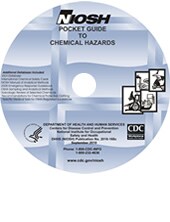
NIOSH Pocket Guide to Chemical Hazards Available for Free Download

The NIOSH Pocket Guide to Chemical Hazards (NPG) is intended as a source of general industrial hygiene information on several hundred chemicals/classes for workers, employers, and occupational health professionals. The NPG does not contain an analysis of all pertinent data, rather it presents key information and data in abbreviated or tabular form for chemicals or substance groupings (e.g. cyanides, fluorides, manganese compounds) that are found in the work environment. The information found in the NPG should help users recognize and control occupational chemical hazards.

Instructions for Downloading:
Download the NPG CD-Rom as a ISO image file and create a disc with CD-ROM authoring software.
The NPG ZIP file contains a condensed version of the NPG.
All non-Pocket Guide links were removed so that this set of files acts as a "stand-alone" database. These files can be used with a standard web browser or on some mobile devices.


  • 2010-168c.zip (245 MB) (requires WinZip or other unzipping software)
  • 2010-168c.exe(181 MB) (Self-extracting zip file for Windows)
  • 2010-168c.isoNIOSH publication number 2010-168c 
    (ISO Requires CD-Rom Authoring Software)

Jumat, 26 November 2010

Hospitals Are Not For Sick People

The New England Journal of Medicine reports that hospitals remain unsafe. A study comparing the last 10 years reflects that there have been no significant changes in safety rates for patients entering hospitals.  For decades the number has been stable, close to 25% of hospital patients get sicker because of unsafe or unhealthy hospital conditions or activities.

"Among 2341 admissions, internal reviewers identified 588 harms (25.1 harms per 100 admissions; 95% confidence interval [CI], 23.1 to 27.2). Multivariate analyses of harms identified by internal reviewers showed no significant changes in the overall rate of harms per 1000 patient-days (reduction factor, 0.99 per year; 95% CI, 0.94 to 1.04; P=0.61) or the rate of preventable harms. There was a reduction in preventable harms identified by external reviewers that did not reach statistical significance (reduction factor, 0.92; 95% CI, 0.85 to 1.00; P=0.06), with no significant change in the overall rate of harms (reduction factor, 0.98; 95% CI, 0.93 to 1.04; P=0.47)."

Adverse complications of medical care provided to injured workers are compensation under workers' compensation. Employers and insurance carriers should encourage safe and harmless medical care for injured workers.

Temporal Trends in Rates of Patient Harm Resulting from Medical Care, N Engl J Med 2010; 363:2124-2134November 25, 2010

Selasa, 23 November 2010

Impact on Disability Claims if the Retirement Age is Raised


The Government Accounting Office has released a report on what I see as the impact on Social Security Disability if Retirement is raised. Let us say you can retire early at age 62 and reach full retirement age at 67. To save money some are proposing to raise the retirement age to retire early and for full retirement. One justification is people are living longer and can work longer. Another justification is an effort to reduce benefits perhaps even looking at dumping it at some point. Blaming Social Security is probably a mistake. It has stabilized or helped stabilize the elderly lifestyle and with medicare made sure they were medically insured. It needs improvement but from my own personal experience it helps the old and disabled to allow at least a modest but decent life. But what if they do tamper with it? This report raises the likelihood of increased disability claims. Perhaps it is wise to study all the ramifications of altering Social Security and not look for simplistic answers that some politicians promote. One man's agenda may be another man's loss. Do unto others may be the rule to abide by here.