Tampilkan postingan dengan label Asbestos. Tampilkan semua postingan

Kamis, 26 Januari 2012

US Asbestos Imports Increases in 2011

The United States has yet to ban asbestos, a known carcinogen, and in 2011 the amount of asbestos that the US imports increased according to US government statistics. It is axiomatic, that the legacy from the this increase of asbestos imports will cause an increase in asbestos related illness in the US 30 years down the road as asbestosis and malignancies such as lung cancer and mesothelioma rise.

The following statement was issued today by Linda Reinstein, Co-Founder, President & CEO of the Asbestos Disease Awareness Organization, regarding the 2012 United States Geological Survey report about the dramatic increase in asbestos importation to the United States:

"As a Mesothelioma widow and asbestos awareness advocate, I was appalled and shocked to discover today that the 2012 United States Geological Survey (USGS) Mineral Commodity Summaries reported asbestos consumption from January through July of 2011 to be 1,100 metric tons; however, when comparing a previous report from January through July of 2010, asbestos consumption was reported to be 820 metric tons. This difference of 280 metric tons represents a 25% increase in consumption. For more than three decades, asbestos has been a known human carcinogen, yet occupational and environmental exposure continues throughout the United States.


There is no safe limit for asbestos exposure. Asbestos should be banned in the US.  The introduction and use of asbestos fiber into the US environment will only perpetuate a legacy of fatal disease for future Americans. 

Click here to read: USGS Mineral Commodity Summaries 2012
"Domestic Production and Use: Asbestos has not been mined in the United States since 2002. The United States is dependent on imports to meet manufacturing needs. Asbestos consumption in the United States was estimated to be 1,100 tons, based on asbestos imports through July 2011. Roofing products were estimated to account for about 60% of U.S. consumption; the chloralkali industry about 35%; and unknown applications, 5%."

Senin, 16 Januari 2012

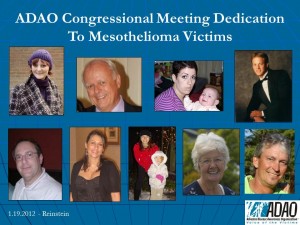
ADAO To Brief US Senate on Asbestos Jan 19, 2012


As part of ADOA's education, advocacy, and community efforts, The Asbestos Disease Awareness Organization ADAO has announced that it plans to hold an educational Senate Briefing, “Asbestos: The Impact on Public Health, the Environment, and the Economy” and meet with government officials in Washington, DC this week. A group of ADAO representatives including Dr. Arthur Frank, Dr. Barry Castleman, Brent Kynoch, Marilyn Amento, and Linda Reinstein will present the most up-to-date facts to members and staffers in the Senate so that they can make informed legislative and policy decisions. Their hope is to offer critical asbestos information and encourage bipartisan interagency collaboration to address a threat that affects all Americans. As always, ADAO will leverage social media to share its experiences. Follow ADAO in Twitter @Linda_ADAO as their intern, Spencer, tweets straight from the Senate Briefing!

Summary and Briefing Facts to Be Released Thursday, January 19, 2012 at 4:00pm

Rabu, 14 Desember 2011

Automobile Mechanics Should Be Cautious About Asbestos Exposure

Many brakes and clutches used in new and recent model automobiles do not contain asbestos. However, it has not been totally eliminated. Some reports have indicated that many mechanics and employees in the automotive repair shops as well as do-it-yourselfers are unaware that asbestos may be present in both old and replacement brakes and clutches.

OSHA’s asbestos standard requires the use of controls and safe work practices when employees work with brake shoes and clutches that contain asbestos. These requirements are detailed in 29 CFR 1910.1001 and specifically 1910.1001(f)(3) and Appendix F of the standard - Work Practices and Engineering Controls for Automotive Brake and Clutch Inspection, Disassembly, Repair and Assembly (http://www.osha.gov/SLTC/asbestos/index.html). The requirements also are discussed in the Federal Register at 59 FR 40964, 40985-87 (August 10, 1994) and 60 FR 33983 (June 29, 1995), as well as in OSHA Directive CPL 2-2.63 (revised).

Asbestos, a naturally occurring mineral fiber that is highly heat resistant, can cause serious health problems when inhaled into the lungs. If products containing asbestos are disturbed, thin, lightweight asbestos fibers can be released into the air. Persons breathing the air may breathe in asbestos fibers. Continued exposure can increase the amount of fibers deposited in the lung. Fibers embedded in the lung tissue over time may result in lung diseases such as asbestosis, lung cancer, or mesothelioma. It can take from 10 to 40 years or more for symptoms of an asbestos-related condition to appear. Smoking increases the risk of developing illness from asbestos exposure.

All automotive brake and clutch repair facilities in the United States must comply with the OSHA asbestos standard. The proper use of engineering controls and work practices by properly trained employees working on automotive brakes and clutches will reduce their asbestos exposure below the permissible exposure level of 0.1 fiber per cubic centimeter of air, expressed as an 8-hour time-weighted average. Respiratory protection is not required during brake and clutch jobs where the control methods described below are used.

The two preferred OSHA methods to control asbestos dust during brake and clutch repair and service are: (1) a negative pressure enclosure/HEPA (high-efficiency particulate air) vacuum system, and (2) the low pressure/wet cleaning method. The employer may use other methods (in conjunction with written procedures), to reduce exposure to levels equivalent to the negative pressure enclosure/HEPA vacuum system. For facilities that inspect, disassemble, reassemble and/or repair five or fewer brake or clutch jobs per week, the wet method (described in paragraph D of Appendix F) can be used. The spray can/solvent system method can be used as an alternative preferred method since it meets the equivalency criterion of the negative pressure enclosure/HEPA vacuum system method. Proper training is essential to ensure that employees use the methods in an effective manner.

More information:
.....
For over 3 decades the Law Offices of Jon L. Gelman  1.973.696.7900  jon@gelmans.com have been representing injured workers and their families who have suffered occupational accidents and illnesses. 

Minggu, 11 Desember 2011

$2 Million Verdict to Plastic Compounder Suffering Mesothelioma - Call For Asbestos Ban

This week a New York state jury awarded $2 Million dolars to a former plastic compounder who was exposed to asbestos fiber and was subsequently diagnosed with mesothelioma. The employee worked in a plastic factory in 1966 and poured raw asbestos fibers to make molds. Some of the asbestos fiber was supplied by Hedman Resources Ltd., a Canadian asbestos mining company.

Mesothelioma is a rare and fatal cancer caused by exposure to asbestos fiber. Hundreds of thousands of lawsuits have been filed against the asbestos manufacturers and producers since the early 1970's in the US seeking benefits. Despite the continuing epidemic of asbestos related disease and massive weight of scientific evidence of the deadly carcinogenic qualities of asbestos, Canada continues to mine asbestos fiber and sell it worldwide. It is estimated that that 107,000 workers die annually from asbestos-related diseases.

To this day there is no asbestos ban in effect in the US. The Canadian asbestos industry still exports asbestos fiber used in the US and other parts of the world. On Thursday, The Asbestos Disease Awareness Organization (ADAO) which combines education, advocacy, and community to provide a unified voice for asbestos victims, today announced with the Canadian Voices of Asbestos Victims the release of the North American Declaration to Eliminate Asbestos-Related Diseases.

The Declaration initiates an enhanced collaboration between the U.S. and Canadian asbestos disease victims and their families, public health organizations, environmental non-governmental organizations, occupational safety and health (OSH) specialists, and politicians. While ADAO has been individually partnering with Canadian counterparts for education, advocacy, and community initiatives for several years now, the North American Declaration for the Elimination of Asbestos-Related Diseases unifies the demands voiced by American and Canadian asbestos victims to eliminate asbestos-caused diseases.


To sign the petition to ban asbestos fiber click here: Petition to Ban Asbestos Fiber 
.....
For over 3 decades the Law Offices of Jon L. Gelman  1.973.696.7900  jon@gelmans.com have been representing injured workers and their families who have suffered occupational accidents and illnesses. 

Rabu, 07 Desember 2011

It is Time To Do The Right Thing


A recent decision by the NJ Courts illustrates the weaknesses of the present workers' compensation system when dealing with occupational exposures. The social remedial system called workers' compensation was designed before recognition of the compensability occupational illnesses. 


The initial system was to furnish benefits without fault and in a summary and remedial fashion to injured workers. For the most part, that system worked from 1911 until the 1950's when the legacy of asbestos, used in World War II to insulate ships, came back to haunt the American worker by the manifestation of latent asbestos diseases including mesothelioma, a rare and fatal cancer.


Recently a NJ court denied the compensability of an asbestos related condition based upon the claimant's own knowledge of the causal relationship of an asbestos related medical condition and his own occupational exposure. Additional the court held that medical expert testimony was not required to support a motion to dismiss for the failure to meet the requirement of the statute of limitations.


In the 1970's the US Department of Labor was concerned with the same weaknesses and unavailability of benefits. The US DOL commissioned the Environmental Sciences Center at the Mt. Sinai School of Medicine under the leadership of the late Irving J. Selikoff, MD to study and analyze the problem. The weaknesses of the system, even though less dramatic than present, led to the conclusion that the workers' compensation systems just didn't work for occupational disease conditions. Additionally, costs for medical treatment of asbestos related conditions were being shifted at an estimated $10 Billion dollars, at that time, to the Medicare system.


Dr. Selikoff studied two major cohorts in analyzing the inadequacies of the  workers' compensation system. One group were insulators, and another group were 933 former plant workers at The Union Asbestos and Rubber Company of Paterson NJ who worked in war production between 1942 and 1944. Strikingly, the dormant medical conditions caused by the occupational exposure to asbestos fiber, and the latent condition of the disease for decades, caused major problems in filing claims. Those included the statute of limitation and diagnosis by medical professionals. Some professional were Grade B readers certified by The National Institute of Occupational Safety and Health (NIOSH) and even those experts in the field were challenged in Court. 


The report, that was submitted to the US Congress, concluded that the failure of the workers' compensation system to provide benefits to many who were exposed to asbestos, and the inadequate benefits to others. Their low rates were based on extremely low wages at the time of exposure. For these and other reasons, the report concluded, that the workers' compensation had failed to adequately provide treatment and other benefits. Since workers' compensation was not meeting the needs, claimants flocked to the tort system in epidemic proportion resulting in "the longest running tort" in American judicial history, "asbestos litigation." That litigation continues to this day. Even scores of companies that have reorganized under bankruptcy to avoid liability exposure are now providing benefits under a claims procedure.


While the NJ Court's decision may have been on point with regard to the Rules adopted to govern workers' compensation cases, it is time to revisit whether the Rules are too strict and defeat the social and remedial goals of the system that was envisioned by the creators in 1911. On a global scale, the failure of the workers' compensation to provide benefits results in the inequitable shift of responsibility to the general taxpayer. 


To meet the needs of those exposed occupationally, Congress needs to act now upon a global and unified solution. One path to the goal of correcting inequities of the system is to advance a system of universal medical care.  The US government must do the right thing. The medical delivery system for occupational diseases must come under a national universal medical care program. Additionally Congress must meet its moral and social responsibility and finally ban asbestos use in the US once and for all.


Read the decision: Russo v. Hoboken Board of Education, A-1861-10T4 (App. Div. November 29, 2011)

"...the WCJ found that he knew asbestos could cause lung disease and other medical problems as early as "the 70s." She noted that Russo "made complaints about the exposures to harmful substances . . . while still teaching." The WCJ further found that Russo "was well aware of the potential harmful effects of asbestos exposure," and she rejected his claim that the petition was not time-barred "because he was never informed by any of his treating physicians that his cancer was related to this exposure."

...
For over 3 decades the Law Offices of Jon L. Gelman  1.973.696.7900  jon@gelmans.com have been representing injured workers and their families who have suffered occupational accidents and illnesses.

Kamis, 01 Desember 2011

The Toxic Legacy of Raybestos-Manhattan Continues

The epic toxic legacy of asbestos brake manufacturer, Raybestos-Manhattan Inc., a/k/a Manhattan Rubber and Raymark, continues as waste from its former plants plagues present communities. Raybestos had several production plants in the US including Connecticut, South Carolina and Passaic, New Jersey.

Asbestos, labeled the "miracle mineral," was a known carcinogen and linked to: asbestosis, lung cancer and mesothelioma, a rare and fatal cancer. The company with knowledge of that information, as revealed in the famous "Sumner Simpson papers," ignored the available science and continued to manufacturer asbestos products including: bowling balls, radiator hoses and brake linings, as well as other products.

While the Raybestos is no longer producing asbestos products, the plants sites continue to be a problem to the communities as a toxic legacy continues.

Read the article Citizen group pushing for new way to detoxify Raymark wastemctpost.com

"STRATFORD -- A network of residents concerned about toxic waste in town is pushing the EPA to study and determine whether a relatively new technology that neutralizes asbestos can be used to detoxify dump sites in the city....." read more 

.......
For over 3 decades the Law Offices of Jon L. Gelman  1.973.696.7900  jon@gelmans.com have been representing injured workers and their families who have suffered occupational accidents and illnesses.

Jumat, 25 November 2011

Asbestos, Railroads and The US Supreme Court


For decades railroad equipment, including engines, were heavily insulated with asbestos fiber, a known carcinogen and causally related to mesothelioma, a rare and fatal cancer. Many lawsuits have been filed by victims and their families to recover benefits against the suppliers, manufacturers and distributors of asbestos fiber. This month, The US Supreme Court heard oral argument to determine whether state laws were preempted under Federal law and that state laws were not applicable in judging the lawsuits.


The initial claims for asbestos related diseases were filed as workers' compensation claims in the United States. Soon it was revealed that the suppliers, distributors and health research (trade) organizations were concealing information to the workers as to the deadly dangers of asbestos fiber. As asbestos related disease, including mesothelioma, became epidemic, tens of thousands of civil claims were filed.


As a result of the long latency period from exposure to asbestos fiber to disease manifestation, the claims continue to be filed on behalf of former workers and their estates. While the exposures are usually multi-faceted, the issue regarding which law will cover railroad claims remains unresolved.


Gloria Gail Kurns, Executrix of the Estate of George M. Corson, Deceased, et al., Petitioners v. Railroad Friction Products Corporation, No. 10-879.


SCOTUSblog Coverage

Briefs and Documents

Merits Briefs for Petitioners
Amicus Briefs in Support of the Petitioners
Merits Briefs for the Respondents
Amicus Briefs in Support of the Respondents
Certiorari-stage Documents
The supplemental briefs in this case make reference to the Solicitor General's brief in Crane v. Atwell, which is available here.    

For over 3 decades the Law Offices of Jon L. Gelman  1.973.696.7900  jon@gelmans.com have been representing injured workers and their families who have suffered occupational accidents and illnesses.


Related articles