Tampilkan postingan dengan label Public health. Tampilkan semua postingan

Senin, 16 Januari 2012

ADAO To Brief US Senate on Asbestos Jan 19, 2012


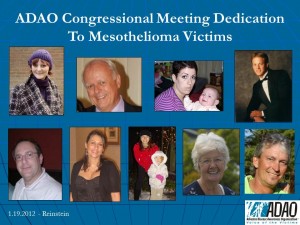
As part of ADOA's education, advocacy, and community efforts, The Asbestos Disease Awareness Organization ADAO has announced that it plans to hold an educational Senate Briefing, “Asbestos: The Impact on Public Health, the Environment, and the Economy” and meet with government officials in Washington, DC this week. A group of ADAO representatives including Dr. Arthur Frank, Dr. Barry Castleman, Brent Kynoch, Marilyn Amento, and Linda Reinstein will present the most up-to-date facts to members and staffers in the Senate so that they can make informed legislative and policy decisions. Their hope is to offer critical asbestos information and encourage bipartisan interagency collaboration to address a threat that affects all Americans. As always, ADAO will leverage social media to share its experiences. Follow ADAO in Twitter @Linda_ADAO as their intern, Spencer, tweets straight from the Senate Briefing!

Summary and Briefing Facts to Be Released Thursday, January 19, 2012 at 4:00pm

Sabtu, 30 Juli 2011

Cell Phones and Cancer: The Static in the Debate

A recently published European study boldly and with much confusion declares that children are not at an increased risk of cancer as a result of cell phone use. Knowledgeable commentators has questioned the reliability of the data and analysis resulting in questioning the veracity of the European study altogether.

Microwave News reported:
'The first study to look at brain tumors among children and teenagers who have used cell phones came out today and it shows no increased risk. Well, actually, the study, known as CEFALO, does indicate a higher risk —the problem is that it found a higher risk for all the kids who used a phone more than once a week for six months, regardless of how much time they spent on the phone. Because the risk does not go up with more use, the CEFALO team argues that the results argue against a true association.

Professor Franklin E. Mier, PhD, CID, Environmental and Occupational Health SciencesCUNY School of Public Health at Hunter College, commented:
"A study may provide "evidence for," or more rarely, evidence against an increased risk associated with an exposure. The exposure should be further characterized by level and duration. The evidence might further be characterized as "clear," "some" or "equivocal." In studies of people, either single studies or a collections of studies, "chance, bias, and confounding" must be evaluated, which impacts the strength of the evidence derived from the study. Studies failing to find an association should be characterized as "null" rather than "negative."

"Each newly published study should be characterized in the context of previous studies, evaluated as a group. IARC characterized the body of evidence previous to the study reported here as "limited." Those who wish to make their own evaluation should read the IARC monograph in detail. Personally, I don't think the body of evidence will ever advance beyond "limited" evidence. Also, resources and media attention will continue to be devoted to restudying this exposure (as opposed to other exposures of concern) because rich people use cell phones.

Dramatically conflicting studies are now surfacing. The signal is not yet clear and the static will have to resolve before the causal connection between cell phone use and cancer can be ruled out.


Related articles

Senin, 11 Juli 2011

Better Control Over Asbestos Contaminated Sites Required

Senator Max Baucus (MT)


The recent discovery of the spread of asbestos contamination in Libby MT, which had been declared a Public Health Emergency, is shocking. Asbestos, a known carcinogen, associated with mesothelioma, is reportedly still lingering throughout the community. 

Montana's senior U.S. Senator Max Baucus vowed to find answers regarding reports today of asbestos-contaminated bark and wood chips being sold in Libby, MT and beyond. 

"We've made tremendous strides in the effort to help Libby heal with health care and environmental cleanup. But trust is essential to Libby's ability to heal psychologically and economically. Now it appears EPA's actions may have put that trust in jeopardy, so you can bet I'll be holding EPA's feet to the fire to find out exactly what they knew, when they knew it, and whether action is needed to ensure the safety of folks in Libby and across the country who were exposed to this bark," Baucus said. "The people of Libby have already been poisoned in the name of greed and I won't allow them to be victimized again because of negligence. We need to work together to make sure safety information is complete and transparent so the community can move forward and create jobs with faith in the agencies and processes that are supposed to protect them."

Since news reports first linked widespread deaths and illness to exposure to deadly asbestos fibers at the defunct W.R Grace and Co. mine, Baucus has visited Libby more than 20 times, secured millions for healthcare and cleanup, brought numerous White House cabinet secretaries to the town, helped save the CARD clinic, and has dogged the EPA to keep cleanup efforts moving forward. 

As far back as 1999, Baucus wrote a letter to then Secretary of Health and Human Services Donna Shalala requesting immediate medical help and assistance to the area. He further lambasted the EPA's decision to not declare a Public Health Emergency, calling it an "outrage." 

In 2008, Baucus released a report detailing a 2002 attempt by the EPA to declare a Public Health Emergency in Libby that was thwarted by the previous Administration's Office of Management and Budget. And on June 17, 2009, due in large part to Baucus' efforts, the EPA declared its first ever public health emergency in Libby, Montana. 

Earlier this year Baucus was announced as the 2011 Tribute of Hope Award recipient by the Asbestos Disease Awareness Organization (ADAO) for his tireless efforts fighting on behalf of residents of Libby, Lincoln County and Asbestos victims everywhere. In March, the Senate unanimously passed Baucus' resolution to designate the first week of April 2011 as "Asbestos Awareness Week," and call attention to Libby and other victims of asbestos-related disease.

The continued spread of this contamination is yet another reason why the US must finally ban asbestos entirely. 
Jumat, 27 Mei 2011

Occupational Safety Recognized as One of the Top Ten Great Health Achievements

During the 20th century, life expectancy at birth among U.S. residents increased by 62%, from 47.3 years in 1900 to 76.8 in 2000, and unprecedented improvements in population health status were observed at every stage of life (1). In 1999, MMWR published a series of reports highlighting 10 public health achievements that contributed to those improvements. This report assesses advances in public health during the first 10 years of the 21st century. Public health scientists at CDC were asked to nominate noteworthy public health achievements that occurred in the United States during 2001--2010.

Occupational Safety

Significant progress was made in improving working conditions and reducing the risk for workplace-associated injuries. For example, patient lifting has been a substantial cause of low back injuries among the 1.8 million U.S. health-care workers in nursing care and residential facilities. In the late 1990s, an evaluation of a best practices patient-handling program that included the use of mechanical patient-lifting equipment demonstrated reductions of 66% in the rates of workers' compensation injury claims and lost workdays and documented that the investment in lifting equipment can be recovered in less than 3 years (45). Following widespread dissemination and adoption of these best practices by the nursing home industry, Bureau of Labor Statistics data showed a 35% decline in low back injuries in residential and nursing care employees between 2003 and 2009.

The annual cost of farm-associated injuries among youth has been estimated at $1 billion annually (46). A comprehensive childhood agricultural injury prevention initiative was established to address this problem. Among its interventions was the development by the National Children's Center for Rural Agricultural Health and Safety of guidelines for parents to match chores with their child's development and physical capabilities. Follow-up data have demonstrated a 56% decline in youth farm injury rates from 1998 to 2009 (National Institute for Occupational Safety and Health, unpublished data, 2011).

In the mid-1990s, crab fishing in the Bering Sea was associated with a rate of 770 deaths per 100,000 full-time fishers. Most fatalities occurred when vessels overturned because of heavy loads. In 1999, the U.S. Coast Guard implemented Dockside Stability and Safety Checks to correct stability hazards. Since then, one vessel has been lost and the fatality rate among crab fishermen has declined to 260 deaths per 100,000 full-time fishers.

Reported by: Domestic Public Health Achievements Team, CDC. Corresponding contributor: Ram Koppaka, MD, PhD, Epidemiology and Analysis Program Office, Office of Surveillance, Epidemiology, and Laboratory Services, CDC; rkoppaka@cdc.gov, 347-396-2847.

For over 3 decades the Law Offices of Jon L. Gelman  1.973.696.7900  jon@gelmans.com have been representing injured workers and their families who have suffered occupational accidents and illnesses.

Jumat, 20 Mei 2011

Nail Salon Workers at Risk for Occupational Exposures

Assorted cosmetics and toolsImage via Wikipedia

Nail salon workers are at risk for exposures to hazardous chemicals at work reports a recently published study. The report in the American Journal of Public Health concludes that workers at nail salons may be at higher risk of exposure to chemical toxins that may be harmful to their health. 


Researchers set out to measure personal and area concentrations of solvents among Vietnamese women working in various California nail salons through a community-based participatory research study. Researchers collected data from 80 Vietnamese female nail salon workers from 20 different nail salons. They measured work-shift concentrations of toluene, ethyl acetate and isopropyl acetate and found that measured levels of these solvents were higher than recommended guidelines to prevent frequently reported health symptoms frequently reported. One-third of workers reported that they experienced certain health symptoms such as irritations, headaches, nausea and breathing problems after entering the workforce. Irritations of the nose, throat, lungs, skin and eyes were the most common symptoms, reported by 26.5 percent of workers. 


“Our findings underscored the need for more attention to preventive public health strategies for his workforce. Recommendations to promote worker health and safety include policy changes to update occupational exposure limits that take into account various chronic health conditions, better regulatory oversight of chemicals in cosmetic products, and more research focused on the health of understudied and vulnerable worker populations,” said the study’s authors.

The Campaign for Safe Cosmetics and several other lobbying groups are supporting the passage of The Safe Cosmetics Act. The pending legislation calls full labeling of salon and cosmetic products and a phase out of those hazardous products that contain products that cause cancer or birth defects. It would allow the US Food and Drug Administration regulatory powers over the manufacture of cosmetics. The proposed legislation would require all ingredients to be listed on the product labels.

Concern has not only been expressed recently by nail salon workers, but various government agencies have issued health alerts concerning the presence of formaldehyde in hair straightening products. The State of New York was the latest to issue a health warning for those who use or are exposed to hair straightening products. 

For over 3 decades the Law Offices of Jon L. Gelman  1.973.696.7900  jon@gelmans.com have been representing injured workers and their families who have suffered occupational accidents and illnesses.

Related articles

Kamis, 19 Mei 2011

NY State Issues Health Alert for Hair Straightening Products and Formaldehyde

The Department of Health of the State of New York has issued a health alert advisory to workers and consumers about a group of hair straightening products known as "Brazilian Keratin Treatment" (BKT) that may contain formaldehyde

The warning advises those exposed that:
  • Exposure to formaldehyde can cause irritation of the eyes, nose, throat, and skin.
  • People with asthma or other respiratory diseases may be more sensitive than others to the effects of breathing formaldehyde.
  • Formaldehyde is classified as a probable human carcinogen (cancer-causing chemical).
  • The Department tested some products, and cautions that others in the market may also contain also formaldehyde. 
A list of 22 products containing formaldehyde include:
  1. BioIonic Kera Smooth Anti Frizz
  2. Brazilian Blowout Solution
  3. Brazilian Blowout Acai Professional Smoothing solution
  4. Brazilian Gloss Keratin Smoothing Gloss
  5. Cadiveu Brazilian Thermal Reconstruction
  6. Coppola Keratin Complex Smoothing Therapy, Natural Keratin Smoothing Treatment
  7. Coppola Keratin Complex Smoothing Therapy, Natural Keratin Smoothing Treatment, Light Wave
  8. Coppola Keratin Express Brazilian Smoothing Treatment
  9. Coppola Keratin Complex Smoothing Therapy
  10. Global Keratin Functional Keratin Hair Taming System Light Wave Chocolate
  11. Global Keratin Taming System Strawberry
  12. Global Keratin Taming System with Juvexin Strawberry Resistant
  13. Global Keratin Taming System with Juvexin Strawberry Light Wave
  14. IBS Beauty IStraight Keratin Advanced Keratin Treatment
  15. JKS International Smoothing Treatment
  16. Kera Green Keratin and Protein Hair
  17. Marcia Teixeira Advanced Brazilian Keratin Treatment
  18. Marcia Teixeira Brazilian Keratin Treatment
  19. Marcia Teixeira Chocolate, extreme de-frizzing treatment
  20. Pravana Naturceuticals Keratin Fusion
  21. Pro-Collagen RX Keratin Treatment
  22. QOD GOLD Solution
Oregon OSHA (health and safety program), Health Canada and the European Directorate-General of Health and Consumer Affairs did the testing and found formaldehyde in each of the products they tested. They also conducted air tests during application of one of the products in two salons and found that formaldehyde had been released into the air.

The New York State Department of Health is monitoring the situation and they are in contact with other states about their experiences with these products. Through this fact sheet, they are taking the precautionary step of alerting salon workers and consumers about the hazards. At this time, they know that 51 companies market a total of 156 products. Over 100 of those are widely distributed in New York. This year alone, seven new products have come on the market. At this time they have no reliable way, at this time, to know which ones contain formaldehyde. The U.S. Food and Drug Administration (FDA), responsible for regulating cosmetic products, is gathering reports from consumers and salon professionals about eye irritation, breathing problems and headaches.

Many other agencies have issued health alerts and taken action. The Oregon Department of Consumer Business Services and the Connecticut Department of Public Health issued alerts on the release of formaldehyde from these products. The Attorney General of the State of California filed a lawsuit against a California-based manufacturer of one of these products (Brazilian Blowout's Acai Professional Smoothing Solution) alleging that the manufacturer failed to warn users about the presence of formaldehyde, as required by California regulations. Health Canada issued an advisory about the release of formaldehyde from the Brazilian Blowout product. Health Canada also received complaints of burning eyes, nose and throat, breathing difficulties and a report of hair loss. The European Directorate-General of Health and Consumer Affairs banned the sale of some products and recalled others.

New York State advises that the following action should be taken if a consumer or professional is concerned about these products: First, consider not having your hair treated with the products.

  • Seek medical attention, if you are experiencing health problems.
  • Consumers and salon professionals are urged to report adverse experiences to FDA in either of the following ways:
  • Report to the nearest FDA district office. The phone number for the New York State Complaint Coordinator is (866) 446-9055.
  • Report online to FDA's MedWatch adverse event reporting system. You also may call Medwatch at (800) 332-1088 to request a reporting form by mail.
For over 3 decades the Law Offices of Jon L. Gelman  1.973.696.7900  jon@gelmans.com have been representing injured workers and their families who have suffered work related accidents and injuries.

Related articles